Thursday, April 29, 2010

The return of the mojo?

So, a few months ago I was spinning and/or knitting every day. Every single day. Even if it was just 10-15 minutes a day, I was working with fiber, and feeling very happy about it.

Then something happened and I just stopped. I still haven't figured out precisely what it was; it's like something just kind of faded, or broke, or disappeared. It was right around the time school started. I finished a project for a baby shower, and then I just stopped knitting. The only time I pulled my spinning wheel out of the corner was a few minutes in March--I showed my spring break team how it worked. And I used the spinning wheel I keep in my office to show my students in Early American Lit. how to spin. All of my fiber time, added up, probably amounted to no more than a half hour.

Did I get too busy? Well, maybe; but school hasn't stopped me this drastically in the past. Did I stop liking fiber? NO. I still love the colors, the feel, the way it seems like magic when you make something out of it. I just didn't want to make anything out of it.

As near as I can figure, something about it felt sad. In fact, there have been parts of this year that felt pretty dang sad, and for no good reason. And somehow knitting and spinning made that more visible, more apparent.

Even as I've been highly aware of the blessings I enjoy every day, I've also felt something lost, something changing this year. I've begun (just barely) reading about "the change," and I think this has something to do with my feelings.

Middle age is not for wimps. Just sayin'.

I'm writing about it now because I'm feeling a shift--ever so small, ever so subtle, but a shift. I've picked up my knitting several times in the last couple weeks. I finished Dexter's Christmas socks (poor kid!) just in time for the weather to get too warm for socks (sheesh; at least I made them a little big so he can wear them in the fall & winter).
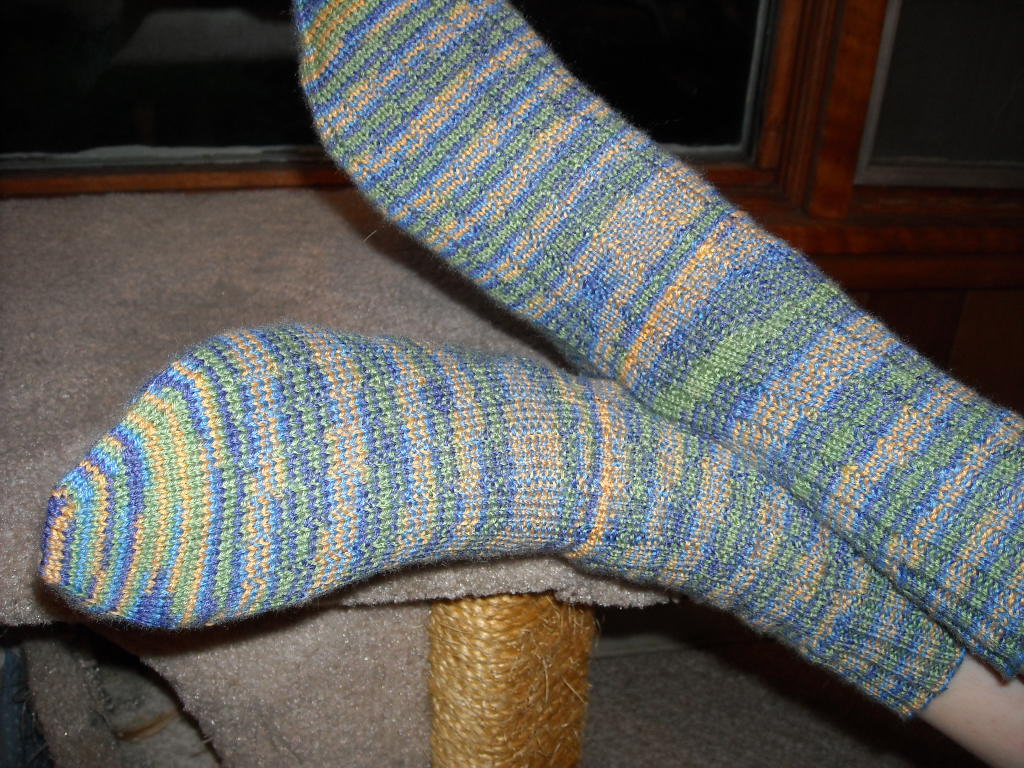

I made a washcloth: last week I pulled out the one I started on the spring break trip when I was teaching a couple of my team members how to knit, and tonight I finished it. I've knitted a few rows on a lace scarf I started back in January. I'm even thinking about getting out the sweater I'm 3/4ths finished and seeing if I feel like tackling the second sleeve.

Just today, my wheel looks like an old friend I'd like to catch up with sometime soon.

Baby steps. I'm not pushing it, just listening inside for what feels right and going with that.

My knitting and spinning mojo was gone. And I mean really gone. But I think I feel it coming back.

May you feel some good mojo today!
Karen

Thursday, April 15, 2010

What I saw this morning


Streaks on the windshield where the dew gathered itself and trickled through the pollen dust.


A carpet of dogwood petals.


(These phrases formed in my head after I listened to an NPR story on poetry on my way to work this morning; the link here doesn't include the piece she read that blew me away, but it's got good stuff nonetheless...)


(And I feel compelled to offer this disclaimer again: I do not write poetry.)


I hope you have a moment to see the signs of spring around you!
Karen

Wednesday, April 14, 2010

On becoming un-stuck

Since our spring break trip I've been thinking about what happened on our first night, and what it might hold for me, for my thought processes.

We got stuck. We were staying at a house at a Methodist camp in the piney woods of Wisconsin. It was late, and dark, and rather cold. We took the wrong road, went past the back of the house instead of the front. And headed straight for the lake. Yikes!

(This is another time we got stuck--on our way out of S.D.!)


The first van stopped on the sandy shore. Sand is not so great a surface if you're trying to back up a rear-wheel drive van. The second van stopped further back--on solid ice. We tried all sorts of things to improve traction in both places: kitty litter, sticks, someone's coat. We dug and we pushed, we rocked the vans. Nothing worked; in fact, things seemed to get worse and worse with everything we tried.

(Maybe the kitty litter will work this time?)

I was not feeling so great, my head filling with anxious thoughts: Both vans are stuck and we're MILES from anywhere. Does Triple-A come out here? Will they have to call a special industrial-strength tow truck because the vans are big? How the heck would such a tow truck get down here without getting stuck as well? How much will it cost? Will we be up all night trying to figure this out? How are we going to tell Triple-A (or whomever) where we are, since we got a little lost on the way here? Have we damaged the transmission already with another 500 miles to drive tomorrow? Are we totally screwed? I need to fix this, I'm one of the "grown-ups" here; what happens if I don't know what to do?

I'm not a person who does really well in situations like this. I wish I could say I am resourceful and calm, a good problem-solver, but the truth is that I'm only occasionally like that. More often, I get nervous. I get scared when I feel like my safety is at risk. And for some reason, that's what it felt like that night.

All that put together meant that I was really talking myself down from a good freak-out. I kept hanging onto being grateful that no one was hurt (yet), and that we would figure out something.

Then somebody thought to call the camp director, who arrived in a few minutes. I thought, okay, at least he will know which tow company to call. But when he arrived, he came ready for ACTION!

He was driving a pickup truck full of good stuff--chains, shovels, a sand spreader--and was wearing a head lamp. Moments later, his staff arrived (staff? I thought nobody was here; it's practically still winter here!), about a half dozen young men and women with Wisconsin accents. And then we witnessed the true miracle of the evening: they were cheerful.

They were not freaked out at all. They were the opposite of freaked out. They kept telling various members of our group, "Oh, this is nothing. We've seen worse. We've seen MUCH worse!" They used the chains, they dug, they coaxed and cajoled and pushed, and in not very long, one van was out--up the hill and onto pavement.

And the whole time, I noticed that no one cussed. Okay, maybe that was the Methodist influence... but they weren't even cranky. No one snapped at anyone else or expressed frustration. No one even implied how pitiful (or worse) we were for getting two vans stuck in the first place. No one had a cross word to say, or even a negative thought, it seemed. They were confident and capable; they were laughing and joking. I was astonished.

(The piney woods of Wisconsin)

Around that time our student leader--who is definitely a problem-solver!--started planning for the next day. I was assigned to sleep so that I could drive the first shift in the morning, which was going to come really early. So I put away my anxious thoughts, and said some prayers to the four directions that the second van would be okay soon and that everyone would emerge from the adventure in one piece.

As I was soothing myself to sleep a while later, I heard a huzzah and knew the second van was out; we were going to be okay. And so I slept.

(The next morning; turkeys crossing the road...)

Every once in a while I think about getting both vans stuck, and I think about the other ways in which I feel stuck sometimes--in my academic writing, in my migraines, in my teaching or learning, in my relationships. And I wonder if I can stop freaking out (or nearly freaking out) and instead pretend I'm one of those people in Wisconsin.

I think about the cheerfulness of our rescuers, how they came in the cold, dark night and not only helped us get the vans out, but helped us feel better.

Is this what it means to get un-stuck? Is this what's possible?

I hope you feel free today,
Karen

Thursday, March 25, 2010

Finding the words


So, the plan to blog from South Dakota? That didn't work out. And when I got back I was immediately overwhelmed with piles of work. (I'm still behind, almost two weeks later!)

And then there's the issue that came up in tonight's Celebration of Spring Break event, where the teams that did service work in various places all get together with some other folks and present some thoughts on the week (in addition to a fun slide show): there's just no way to put it all in words.

As Kelly said tonight, when you come back from a week like that and people ask, "How was it?" and you know they want the 30-second version, it's impossible to express how it was. Even the five-minute version isn't adequate; I'm not even sure the one-hour version would do it. It's hard to find the words to explain how one week on the rez can make you feel like everything's different. How the heck did that happen?

But last week the folks at the chaplain's office who put together these projects asked me to speak tonight, so I started thinking just how I would write about it, what I would say to try to give a feeling of what it was like and what we came back with. Here are my remarks from tonight, which almost kindasorta came out in a near-poem (once you get past the introduction part). (At first I added photo captions, but then I took them out because they seemed disruptive. And at some point I'd like to add in some photos that others took...)

Thanks to Donna and Russell Masartis (the amazing folks who run Tree of Life) and my teammates, who are the inspiration for this: Maria Fullenkamp, Stephanie Heiser, Chris Mickens, Liz Spragens, Matt Hill, Sam Chonko, Linh Nguyen, Becca Salinas, Briana Gunter, Abby Dockter, and Kristen Scott. They are all AWESOME, and I feel privileged to know them.

Hope you enjoy it,
Karen


Mitakuyepi, Karen Poremski emaciyape ksto, nahan eyuha cante wasteya nape ciyuzape.

My relatives, my name is Karen Poremski and I come to you with a warm handshake and good feelings in my heart.

I am one of the co-advisors of the Lakota Nation trip; we worked for Tree of Life, an agency that provides home rehabilitation, a thrift store, a soup kitchen, nursing home visits, school visits, and various other forms of support to the people of the Sicangu Lakota nation (known by the federal government as the Rosebud Sioux tribe). We worked for Tree of Life during the day, and in the evening were visited and taught by various elders and leaders on the rez: Dolores Kills in Water, Albert White Hat, Butch Artichoker, Steve Tamayo, and Mike Marshall (and, sort of accidentally along the way by Shane and Noella Red Hawk).

I’m going to try to tell you what our experience was like…


Mitakuye oyas’in!

That means “all my relations,” or “all my relatives.” And on our trip to be with the Sicangu Lakota, through what we did and what we witnessed, we learned just what that can mean.

-- Before we even got to South Dakota, we learned that it means someone will come help you when it’s dark and cold and BOTH vans are stuck by a lake in Wisconsin. And these someones, these strangers who are your relatives, will be intrepid, brave, and actually cheerful!


-- We learned that the staff at Tree of Life—people who practice Christianity and people who practice traditional native ceremonies—can work together to make something good on the rez.


-- We learned that it means when you go to work on a house and the family has nothing—and I mean nothing: mud for a front yard, with four dogs and a cat wandering around; a two-bedroom house for your extended family, and part of that house is condemned because of the snakes; grime covering your food containers; and no sheets on the bed—when you go to work in this family’s house, they will offer you a Sprite. Even though they have nothing.

-- We learned that it means when you have nothing to give, you can give a smile, or make someone laugh.


-- We learned it means that the elderly man you just met today in the nursing home will want you to write to him; and the elderly woman who plays a mean game of bowling is going to ask you at least three more times this afternoon, “Are you coming back tomorrow?”; and the elderly woman whose father-in-law was Black Elk tells you a bizarre story about a skunk and you both laugh so hard you’re crying; and the young woman there who was paralyzed in a car accident ten years ago, a descendant of Red Cloud, will want you to call her.


-- We learned that it means that everyone is a relative, even the person at the Indian School who discourages you, who tells you that what you’re doing here is meaningless, won’t change anything, won’t help anyone; even that relative will teach you, in her frustration and heart-brokenness, what it means to face inconceivable obstacles.

-- We learned that it means visiting your relatives the prairie dogs, and trying to call your relatives the buffalo, and maybe sneaking a little lunchmeat to the cats hanging around the back door, who are also your relatives.


-- We learned that it means carrying sheetrock and carrying doors and carrying lumber and sorting screwdrivers and drills and tape measures and gloves and figuring out how to build a cabinet.

-- We learned that it means going back and working on the tile again, even after you’ve discovered you hate working on tile.

-- We learned that it means sharing your frybread. Even when you don’t really want to.

-- We learned that it means when you make a mistake you’re forgiven.

-- We learned that it means responding to three suicide attempts in one day, and praying to say the right words that will give all three of those young people hope.


-- We learned that it means mentoring two middle-school boys—showing them how to make dream catchers and regalia and how to play hand games—and knowing that, even if their parents don’t seem to take notice (because they’ve never bothered to meet you), and even if it’s just two boys and so many more are going to be lost to drugs and alcohol and hopelessness and maybe suicide, still, you’re doing a good thing because you’re their relative.

What we learned seemed sometimes a bit mundane, or small, or maybe unimportant or unnoticeable. But I’m here to tell you that it has the potential to change. Because it can change your heart. And that’s the only way to change the world, isn’t it? Isn’t that the place we need to begin?

Mitakuye oyas’in!

Friday, March 5, 2010

Doing things I'm afraid to do...

My very wise friend Nina gave me some advice, through an inspirational quote, recently. It says, "You gain strength, courage, and confidence by every experience in which you really stop to look fear in the face... Do the thing you think you cannot do." (Eleanor Roosevelt said that.)

Well, I am taking that advice to heart, and here I go doing SEVERAL things I previously thought I could not do, and that I'm in fact afraid to do... we'll see how it goes!

First of all, we are having people over to dinner tonight--including us, there will be 20 for dinner. !!!!! I cannot even tell you how much of a panic this would have had me in a couple years ago. Where will we put all those people? Do we have enough bowls, spoons, etc. for everyone to be able to eat? Here's how I'm talking myself out of panic: It will be fun. It will be like an indoor picnic. We will mingle in smaller groups and move between rooms and people will talk and laugh and it'll all be okay. They will not think I'm Martha Stewart, but really, I don't want to be Martha.

The folks coming to dinner are the students I'm going to be traveling with for the next week, my co-advisor, and the co-advisor's family. Which brings me to the next thing I'm doing, and it's pretty scary.

I'm going to the Rosebud Reservation with this group, and we'll be there to do service work in the daytime (doing home rehab, serving in a soup kitchen, helping at the thrift store) and then in the evenings we'll learn about Lakota culture from elders in the tribe. It's a fantastic experience. I've done it before (with two previous groups), and this is the place I stayed at for a month last year on sabbatical (the originating inspiration for the blog!). So there's a lot here that's familiar. And in fact, in some ways I feel like I'm going home. (A part of me comes alive west of the Missouri River, doncha know.)

The trip is a challenge in part because it forces me to confront strong feelings while I am with students. There's a pretty good chance I will need to cry at some point, and there will be a group of ten students witnessing that. In years past, this would have immobilized me with fear. Now, I figure they'll see I'm a human being having an appropriate reaction to the conditions we will be witnessing, both difficult and beautiful. I no longer have to be the one who's in control in front of students all the time. If for no other reason, this trip is valuable for that piece of growth!

So here's what's new: I have been making lists, packing, and running errands for several days now, and ordinarily I would be beside myself with the idea that I might forget something. I would be checking and double-checking and making calls and running more errands, stuffing things into my bags "just in case"...

But not this time. This time, I'm going to do my best to remember to take what I need, and NOT get upset if I forget something. I will learn to live without it for a week. I'm trying to "go with the flow" a bit more, trying to be a little more relaxed about some of the eight thousand details in a trip like this. The important stuff? Okay, that's worth making sure I've got...

Money, checks to pay for things, and insurance forms? Check.

Clothes to work in? Check.


Tobacco for the elders? Check. (It's for ceremonial use!)


Donations of coats, boots, and various wintery things for the kids on the rez? Check. (I have the most kind-hearted friends a person could know!)


Tobacco ties that the group made to take with us & help us pray? Check!

I'm also taking a little bit of school work, some sweat lodge clothes (I hope I hope I hope I get to do the sweat lodge this year), my laptop (hoping to blog while there), and other stuff.


We've even got a bag for each of the vans--stuff we might need on the road.

But whatever's not packed later tonight will stay home, and I will not be upset about it. Dinner will be chaotic and wacky, and I will be happy. Woohoo!

May you do something brave today!
Karen

Monday, March 1, 2010

My trusty steed

Recently I noted on Facebook (my new obsession) that I had just filled up my car's gas tank for only the 2nd time this year. I was quite proud that I'm trying to contribute as little as possible to the profit of the oil companies. Of course, unlike most people in this country, I have the option of NOT driving to work, so that makes it lots easier for me. (Perhaps I shouldn't be too proud!)

I have a funny relationship with my car. Even though I like not having to use it much, I also love being able to use it when I need to. From the time I was a teenager, feeling absolutely STUCK in the suburbs, at various points in my life a car has meant freedom to me. So in that way I'm pretty typically American. But I also have found it really difficult to spend real money on a car.

My first car was a used 1982 Ford Escort, which I nicknamed my little burro. When I lived in the city (D.C.), I left it at home and used Metro to get to work, but it got me to my horseback riding lessons quite nicely. It got me and my brother all the way across the country in the summer of 1990 without much trouble (a broken hose somewhere along the way, but that was it). After living in San Francisco for about a year and finding that--thanks to excellent public transportation--the only time I drove it was to move it for street cleaning, I decided to sell it. It scared me at first to be without a car, but I realized that if I really needed one, I could rent one. It ended up being a good decision.

Fast forward a few years to Atlanta, a city in which you definitely need a car. We had one, but after Dexter came along and Patrick had a full-time Monday through Friday job, we needed a second car. I looked into taking Dexter to daycare on the bus and then going from there to school, but it turned out that the 3-mile trip, with transfers, would take about an hour and a half. Crazy, right? So we bought a 1991 Honda that a friend of a friend was selling.

And that's the car I'm still driving! Here it is:


Every year, I think maybe I'll get one more year out of this car before it's time to donate it... I used to think about selling it to a student, but they drive MUCH nicer (and newer) cars than this one! Its various plastic parts are starting to break (the most recent was a door lock); it's got a mysterious problem with the dashboard fuses that will take too much money to investigate and fix. And I'm afraid the rusty bits are growing (as you can see in the photo). It's practically a rezmobile. But it's a likely little machine, it gets me where I'm going, and it's a Honda, so it's hearty.

Some days, I'm a little bit like Philbert when he decides to buy a "pony" from the junk yard... (Go here and have a look-see. :) ) My car's dings and booboos endear it to me, somehow. Maybe it's a metaphor for how I'm trying to appreciate my own aging self...

May you enjoy some mobility today!
Karen

Sunday, February 21, 2010

Read 'em and weep

I have in front of me today a collection of things I need to read that's so disjointed, disharmonious, dis?? that it's hard to wrap my head around. The individual works in and of themselves make perfect sense; it's the mashing them together that's kind of wacky.

First, there is the homework for my Early American Lit. class: excerpts by Cotton Mather, noted Puritan theologian/historian (and witch hunter). We're reading part of his magnus opus Magnalia Christi Americana (approximate translation: the magnificent works of Christ in America) and a brief bit from Wonders of the Invisible World, in which he explains his use of spectral evidence in the witch trials. At the same time, I have been downloading some world music onto my new toy (the iPod Touch, which I have nicknamed my iCrackmachine).

(I feel like this activity might have made the time-space continuum a bit wobbly...)

Then, there's the purely practical: a chapter on report-writing from the textbook Business and Administrative Communication; I'll be covering this chapter on Tuesday. I need to say two things about this book. First of all, it's extremely useful. There is ALL KINDS of good info. there for people who are writing all the genres we encounter in the world of work--letters, memos, proposals, etc.

But, secondly, I must also note that it is sometimes dry. As the Sahara. Or the Gobi. Or the Mojave. Imagine the special torture it is for someone who pursued a Ph.D. in literature (a most impractical endeavor) because she loves to read, and now this is what she reads every spring so as to teach a course that students want to take. Pity me, my friends.

And, as a treat, I get to read one of my favorite Louise Erdrich novels:

... and on Wednesday I get to talk about it with one of my favorite students, who is taking an independent study with me on Native American women writers. I love this novel with a mighty, mighty love. I haven't read it in a while, so it's wonderful to be enjoying it again. It's like eating chocolate mousse. Or soaking in a hot bath. Or feeling the breeze on your face on a 75-degree day. Just wonderful.

It almost makes up for having to read about how to write business reports...

May you read something wonderful today!
Karen