Monday, May 24, 2010

One of the perqs

One of the best things about working in academia is that I get to see writers reading their work in person. We have a number of writers who come to our campus each year to give readings and answer questions--about their subject matter, about their process. Going to hear them is like enjoying a little oasis in the usual routine of classes, meetings, e-mail; it's a little island of creativity and ideas and language. It reminds me of why I aimed myself toward this career in the first place: I love the written word, and I love hearing stories.

Just recently I was able to go hear a reading at another campus down the road apiece (Ohio State) in the big city (I felt like such a country mouse!).

(There was even traffic! Oh my!)

I made a point of clearing my calendar for the afternoon so that I could make the trek down there because this reading was being given by the person who wrote one of my all-time favorite novels:


LeAnne Howe!

She showed a few minutes of Playing Pastime, a documentary she created with James Fortier about baseball in Indian Country, read from Miko Kings: An Indian Baseball Story (the novel), and answered questions.

In addition to writing poetry, fiction, drama, and documentary, she is also responsible for theorizing one of the most compelling ideas in American Indian Studies, to my way of thinking: tribalography. (Is there anything this woman can't do? She even has a blog. And has appeared on The Daily Show.) For a complete exploration of it, you'll want to read her chapter in the book Clearing a Path: Theorizing the Past in Native American Studies (ed. Nancy Shoemaker), but one of its foundations is that the way we tell a story about something or someone shapes how we understand that thing, and that, because of this, storytelling makes things happen. Wow.

(Okay, I cheated a bit: this is a photo of her reading back in March at another university, but I was so busy listening & taking notes during her reading that I didn't take any photos 'til later...)

In the Q&A period at the reading, she focused more on explaining another thread of tribalography: that it is more inclusive than autobiography and history, that it includes people from the past and present, Indians and non-Indians, working together to make and understand the world. It's a compelling vision of how we all work together, through the endless varieties of our creations, to tell a story of who we are...

One of the things we asked her to clarify at the reading was something she called "my fictional life, or my life in fiction." She said that everyone sees himself or herself as a fictional character, imagines the self in a story, but that this is especially true for writers. She said that when she finishes a writing project, she executes the self she was during that project; she will never be that person again. With the next project, she has to rebirth herself, continue the process of finding out who she is. (This theory reminded me of reader-response theory, only from the writer's perspective, and a lot more intense!)

My big disappointment was that I didn't find out about her second talk of the visit (the next day) until my calendar had stuff on it I couldn't rearrange. She presented new work on mounds--what they mean, how they function, what they tell us... Having been to the Newark Earthworks Day events the past few years, and living now in an area of the country where these sacred structures are all over, I'm keenly interested in this topic. I guess I'll have to wait, like the rest of us, until her new work is published!

Okay, now here's the non-intellectual part of this post: I was thrilled to meet LeAnne and chat with her.

(Could my smile be any bigger? I don't think so..)

Miko Kings
is one of my favorite novels of all time. Why? Because I fell in love with the characters, and my heart breaks and soars with them; because I believe the woo-woo parts**; because it includes journal pages and marginalia (written by a character) and newspaper articles from the early 1900s and a song by John Lennon and quantum physics; because the characters--all of them, Indian and non-Indian--seem like people I might have met; because it makes me feel like I'm in Oklahoma in 1907, a setting I hadn't given much thought to before; and because it makes me feel like we are all making a world together and everything matters--baseball, mathematics, songs, stories, language, weather, all of it.

I love LeAnne Howe's work and was thrilled to meet her because I feel in my bones that she is telling the truth about us. She is onto something.

May you experience something true today!
Karen

** In academic circles, this is more properly known as magical realism--you know, stuff about ghosts and whatnot. But the term is controversial, in part because it implies that the more magical stuff that happens in life is not, in fact, real... which some of us might argue with...

P.S. Most college campuses have readings and lectures all the time, and most are free and open to the public, so if you'd like to experience an oasis of creativity, check out your nearest college campus and make some time in your schedule for something to feed your soul!

Monday, May 10, 2010

Happiness hangover

All day today I was kind of tired & buzzy in my head. I frantically finished the last of my grading (with hours to spare, don't know why I was frantic), had lunch with colleagues at the annual "we made it through the year" lunch (that's not what it's really called, but that's what it feels like), and met with a colleague to talk about her assignment on the committee I chair. I got lots done, but I felt a little run down, a little toasty-crispy around the edges, all day.

I think I had a happiness hangover from all the hugs I got and gave between Saturday afternoon and Sunday afternoon.

On Saturday afternoon I went to a couple graduation parties and met the families of a couple of my students. That was a HOOT! And on Saturday night "the boys" and I went to the Baccalaureate service at school.

Where I won a big-deal award.

The Religious Life division gave me the award for faculty member of the year. I was kind of stunned when I got the announcement (the week before): I do not belong to a church; I do not profess Christianity; and I do not engage in my spiritual practice at school. But as it turns out, that didn't matter. What mattered was that I brought my spirit-self forward into my work-self. I do not, by any means, talk about my beliefs in the classroom; but my beliefs inform how I behave, how I conduct myself with others, the seriousness with which I take my task and the compassion with which I treat my students, my subject matter, my self.


(me with Amber, fabulous student and speaker at Baccalaureate)


And I think partly they thought of me for this award through my work with the spring break trip to the rez. Which I would gladly do, forever and ever, if no one ever noticed. It means so much to me, and feeds my soul, and I get to see the students learn and change before my eyes. Amazing.

(Kristen, another fabulous senior, and Dexter, who thinks she's the coolest babysitter)
And then there was graduation on Sunday. I had reason to give hugs--the graduates I'm so proud of and am going to miss so much. But others were hugging me, too, hearing my news.

So there were lots of hugs, and handshakes, and hearty congratulations. And I think it kind of wore me out a little. But that's okay; it's a nice hangover to have.

Hope you experience a nice hug today!
Karen

Thursday, April 29, 2010

The return of the mojo?

So, a few months ago I was spinning and/or knitting every day. Every single day. Even if it was just 10-15 minutes a day, I was working with fiber, and feeling very happy about it.

Then something happened and I just stopped. I still haven't figured out precisely what it was; it's like something just kind of faded, or broke, or disappeared. It was right around the time school started. I finished a project for a baby shower, and then I just stopped knitting. The only time I pulled my spinning wheel out of the corner was a few minutes in March--I showed my spring break team how it worked. And I used the spinning wheel I keep in my office to show my students in Early American Lit. how to spin. All of my fiber time, added up, probably amounted to no more than a half hour.

Did I get too busy? Well, maybe; but school hasn't stopped me this drastically in the past. Did I stop liking fiber? NO. I still love the colors, the feel, the way it seems like magic when you make something out of it. I just didn't want to make anything out of it.

As near as I can figure, something about it felt sad. In fact, there have been parts of this year that felt pretty dang sad, and for no good reason. And somehow knitting and spinning made that more visible, more apparent.

Even as I've been highly aware of the blessings I enjoy every day, I've also felt something lost, something changing this year. I've begun (just barely) reading about "the change," and I think this has something to do with my feelings.

Middle age is not for wimps. Just sayin'.

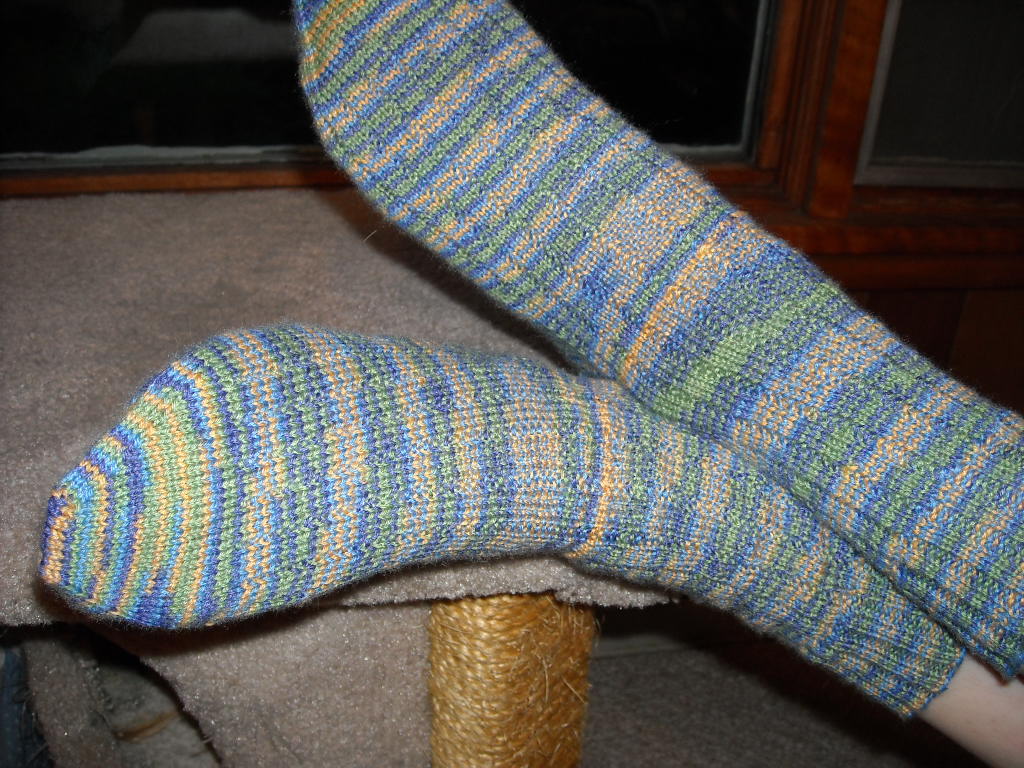
I'm writing about it now because I'm feeling a shift--ever so small, ever so subtle, but a shift. I've picked up my knitting several times in the last couple weeks. I finished Dexter's Christmas socks (poor kid!) just in time for the weather to get too warm for socks (sheesh; at least I made them a little big so he can wear them in the fall & winter).


I made a washcloth: last week I pulled out the one I started on the spring break trip when I was teaching a couple of my team members how to knit, and tonight I finished it. I've knitted a few rows on a lace scarf I started back in January. I'm even thinking about getting out the sweater I'm 3/4ths finished and seeing if I feel like tackling the second sleeve.

Just today, my wheel looks like an old friend I'd like to catch up with sometime soon.

Baby steps. I'm not pushing it, just listening inside for what feels right and going with that.

My knitting and spinning mojo was gone. And I mean really gone. But I think I feel it coming back.

May you feel some good mojo today!
Karen

Thursday, April 15, 2010

What I saw this morning


Streaks on the windshield where the dew gathered itself and trickled through the pollen dust.


A carpet of dogwood petals.


(These phrases formed in my head after I listened to an NPR story on poetry on my way to work this morning; the link here doesn't include the piece she read that blew me away, but it's got good stuff nonetheless...)


(And I feel compelled to offer this disclaimer again: I do not write poetry.)


I hope you have a moment to see the signs of spring around you!
Karen

Wednesday, April 14, 2010

On becoming un-stuck

Since our spring break trip I've been thinking about what happened on our first night, and what it might hold for me, for my thought processes.

We got stuck. We were staying at a house at a Methodist camp in the piney woods of Wisconsin. It was late, and dark, and rather cold. We took the wrong road, went past the back of the house instead of the front. And headed straight for the lake. Yikes!

(This is another time we got stuck--on our way out of S.D.!)


The first van stopped on the sandy shore. Sand is not so great a surface if you're trying to back up a rear-wheel drive van. The second van stopped further back--on solid ice. We tried all sorts of things to improve traction in both places: kitty litter, sticks, someone's coat. We dug and we pushed, we rocked the vans. Nothing worked; in fact, things seemed to get worse and worse with everything we tried.

(Maybe the kitty litter will work this time?)

I was not feeling so great, my head filling with anxious thoughts: Both vans are stuck and we're MILES from anywhere. Does Triple-A come out here? Will they have to call a special industrial-strength tow truck because the vans are big? How the heck would such a tow truck get down here without getting stuck as well? How much will it cost? Will we be up all night trying to figure this out? How are we going to tell Triple-A (or whomever) where we are, since we got a little lost on the way here? Have we damaged the transmission already with another 500 miles to drive tomorrow? Are we totally screwed? I need to fix this, I'm one of the "grown-ups" here; what happens if I don't know what to do?

I'm not a person who does really well in situations like this. I wish I could say I am resourceful and calm, a good problem-solver, but the truth is that I'm only occasionally like that. More often, I get nervous. I get scared when I feel like my safety is at risk. And for some reason, that's what it felt like that night.

All that put together meant that I was really talking myself down from a good freak-out. I kept hanging onto being grateful that no one was hurt (yet), and that we would figure out something.

Then somebody thought to call the camp director, who arrived in a few minutes. I thought, okay, at least he will know which tow company to call. But when he arrived, he came ready for ACTION!

He was driving a pickup truck full of good stuff--chains, shovels, a sand spreader--and was wearing a head lamp. Moments later, his staff arrived (staff? I thought nobody was here; it's practically still winter here!), about a half dozen young men and women with Wisconsin accents. And then we witnessed the true miracle of the evening: they were cheerful.

They were not freaked out at all. They were the opposite of freaked out. They kept telling various members of our group, "Oh, this is nothing. We've seen worse. We've seen MUCH worse!" They used the chains, they dug, they coaxed and cajoled and pushed, and in not very long, one van was out--up the hill and onto pavement.

And the whole time, I noticed that no one cussed. Okay, maybe that was the Methodist influence... but they weren't even cranky. No one snapped at anyone else or expressed frustration. No one even implied how pitiful (or worse) we were for getting two vans stuck in the first place. No one had a cross word to say, or even a negative thought, it seemed. They were confident and capable; they were laughing and joking. I was astonished.

(The piney woods of Wisconsin)

Around that time our student leader--who is definitely a problem-solver!--started planning for the next day. I was assigned to sleep so that I could drive the first shift in the morning, which was going to come really early. So I put away my anxious thoughts, and said some prayers to the four directions that the second van would be okay soon and that everyone would emerge from the adventure in one piece.

As I was soothing myself to sleep a while later, I heard a huzzah and knew the second van was out; we were going to be okay. And so I slept.

(The next morning; turkeys crossing the road...)

Every once in a while I think about getting both vans stuck, and I think about the other ways in which I feel stuck sometimes--in my academic writing, in my migraines, in my teaching or learning, in my relationships. And I wonder if I can stop freaking out (or nearly freaking out) and instead pretend I'm one of those people in Wisconsin.

I think about the cheerfulness of our rescuers, how they came in the cold, dark night and not only helped us get the vans out, but helped us feel better.

Is this what it means to get un-stuck? Is this what's possible?

I hope you feel free today,
Karen

Thursday, March 25, 2010

Finding the words


So, the plan to blog from South Dakota? That didn't work out. And when I got back I was immediately overwhelmed with piles of work. (I'm still behind, almost two weeks later!)

And then there's the issue that came up in tonight's Celebration of Spring Break event, where the teams that did service work in various places all get together with some other folks and present some thoughts on the week (in addition to a fun slide show): there's just no way to put it all in words.

As Kelly said tonight, when you come back from a week like that and people ask, "How was it?" and you know they want the 30-second version, it's impossible to express how it was. Even the five-minute version isn't adequate; I'm not even sure the one-hour version would do it. It's hard to find the words to explain how one week on the rez can make you feel like everything's different. How the heck did that happen?

But last week the folks at the chaplain's office who put together these projects asked me to speak tonight, so I started thinking just how I would write about it, what I would say to try to give a feeling of what it was like and what we came back with. Here are my remarks from tonight, which almost kindasorta came out in a near-poem (once you get past the introduction part). (At first I added photo captions, but then I took them out because they seemed disruptive. And at some point I'd like to add in some photos that others took...)

Thanks to Donna and Russell Masartis (the amazing folks who run Tree of Life) and my teammates, who are the inspiration for this: Maria Fullenkamp, Stephanie Heiser, Chris Mickens, Liz Spragens, Matt Hill, Sam Chonko, Linh Nguyen, Becca Salinas, Briana Gunter, Abby Dockter, and Kristen Scott. They are all AWESOME, and I feel privileged to know them.

Hope you enjoy it,
Karen


Mitakuyepi, Karen Poremski emaciyape ksto, nahan eyuha cante wasteya nape ciyuzape.

My relatives, my name is Karen Poremski and I come to you with a warm handshake and good feelings in my heart.

I am one of the co-advisors of the Lakota Nation trip; we worked for Tree of Life, an agency that provides home rehabilitation, a thrift store, a soup kitchen, nursing home visits, school visits, and various other forms of support to the people of the Sicangu Lakota nation (known by the federal government as the Rosebud Sioux tribe). We worked for Tree of Life during the day, and in the evening were visited and taught by various elders and leaders on the rez: Dolores Kills in Water, Albert White Hat, Butch Artichoker, Steve Tamayo, and Mike Marshall (and, sort of accidentally along the way by Shane and Noella Red Hawk).

I’m going to try to tell you what our experience was like…


Mitakuye oyas’in!

That means “all my relations,” or “all my relatives.” And on our trip to be with the Sicangu Lakota, through what we did and what we witnessed, we learned just what that can mean.

-- Before we even got to South Dakota, we learned that it means someone will come help you when it’s dark and cold and BOTH vans are stuck by a lake in Wisconsin. And these someones, these strangers who are your relatives, will be intrepid, brave, and actually cheerful!


-- We learned that the staff at Tree of Life—people who practice Christianity and people who practice traditional native ceremonies—can work together to make something good on the rez.


-- We learned that it means when you go to work on a house and the family has nothing—and I mean nothing: mud for a front yard, with four dogs and a cat wandering around; a two-bedroom house for your extended family, and part of that house is condemned because of the snakes; grime covering your food containers; and no sheets on the bed—when you go to work in this family’s house, they will offer you a Sprite. Even though they have nothing.

-- We learned that it means when you have nothing to give, you can give a smile, or make someone laugh.


-- We learned it means that the elderly man you just met today in the nursing home will want you to write to him; and the elderly woman who plays a mean game of bowling is going to ask you at least three more times this afternoon, “Are you coming back tomorrow?”; and the elderly woman whose father-in-law was Black Elk tells you a bizarre story about a skunk and you both laugh so hard you’re crying; and the young woman there who was paralyzed in a car accident ten years ago, a descendant of Red Cloud, will want you to call her.


-- We learned that it means that everyone is a relative, even the person at the Indian School who discourages you, who tells you that what you’re doing here is meaningless, won’t change anything, won’t help anyone; even that relative will teach you, in her frustration and heart-brokenness, what it means to face inconceivable obstacles.

-- We learned that it means visiting your relatives the prairie dogs, and trying to call your relatives the buffalo, and maybe sneaking a little lunchmeat to the cats hanging around the back door, who are also your relatives.


-- We learned that it means carrying sheetrock and carrying doors and carrying lumber and sorting screwdrivers and drills and tape measures and gloves and figuring out how to build a cabinet.

-- We learned that it means going back and working on the tile again, even after you’ve discovered you hate working on tile.

-- We learned that it means sharing your frybread. Even when you don’t really want to.

-- We learned that it means when you make a mistake you’re forgiven.

-- We learned that it means responding to three suicide attempts in one day, and praying to say the right words that will give all three of those young people hope.


-- We learned that it means mentoring two middle-school boys—showing them how to make dream catchers and regalia and how to play hand games—and knowing that, even if their parents don’t seem to take notice (because they’ve never bothered to meet you), and even if it’s just two boys and so many more are going to be lost to drugs and alcohol and hopelessness and maybe suicide, still, you’re doing a good thing because you’re their relative.

What we learned seemed sometimes a bit mundane, or small, or maybe unimportant or unnoticeable. But I’m here to tell you that it has the potential to change. Because it can change your heart. And that’s the only way to change the world, isn’t it? Isn’t that the place we need to begin?

Mitakuye oyas’in!

Friday, March 5, 2010

Doing things I'm afraid to do...

My very wise friend Nina gave me some advice, through an inspirational quote, recently. It says, "You gain strength, courage, and confidence by every experience in which you really stop to look fear in the face... Do the thing you think you cannot do." (Eleanor Roosevelt said that.)

Well, I am taking that advice to heart, and here I go doing SEVERAL things I previously thought I could not do, and that I'm in fact afraid to do... we'll see how it goes!

First of all, we are having people over to dinner tonight--including us, there will be 20 for dinner. !!!!! I cannot even tell you how much of a panic this would have had me in a couple years ago. Where will we put all those people? Do we have enough bowls, spoons, etc. for everyone to be able to eat? Here's how I'm talking myself out of panic: It will be fun. It will be like an indoor picnic. We will mingle in smaller groups and move between rooms and people will talk and laugh and it'll all be okay. They will not think I'm Martha Stewart, but really, I don't want to be Martha.

The folks coming to dinner are the students I'm going to be traveling with for the next week, my co-advisor, and the co-advisor's family. Which brings me to the next thing I'm doing, and it's pretty scary.

I'm going to the Rosebud Reservation with this group, and we'll be there to do service work in the daytime (doing home rehab, serving in a soup kitchen, helping at the thrift store) and then in the evenings we'll learn about Lakota culture from elders in the tribe. It's a fantastic experience. I've done it before (with two previous groups), and this is the place I stayed at for a month last year on sabbatical (the originating inspiration for the blog!). So there's a lot here that's familiar. And in fact, in some ways I feel like I'm going home. (A part of me comes alive west of the Missouri River, doncha know.)

The trip is a challenge in part because it forces me to confront strong feelings while I am with students. There's a pretty good chance I will need to cry at some point, and there will be a group of ten students witnessing that. In years past, this would have immobilized me with fear. Now, I figure they'll see I'm a human being having an appropriate reaction to the conditions we will be witnessing, both difficult and beautiful. I no longer have to be the one who's in control in front of students all the time. If for no other reason, this trip is valuable for that piece of growth!

So here's what's new: I have been making lists, packing, and running errands for several days now, and ordinarily I would be beside myself with the idea that I might forget something. I would be checking and double-checking and making calls and running more errands, stuffing things into my bags "just in case"...

But not this time. This time, I'm going to do my best to remember to take what I need, and NOT get upset if I forget something. I will learn to live without it for a week. I'm trying to "go with the flow" a bit more, trying to be a little more relaxed about some of the eight thousand details in a trip like this. The important stuff? Okay, that's worth making sure I've got...

Money, checks to pay for things, and insurance forms? Check.

Clothes to work in? Check.


Tobacco for the elders? Check. (It's for ceremonial use!)


Donations of coats, boots, and various wintery things for the kids on the rez? Check. (I have the most kind-hearted friends a person could know!)


Tobacco ties that the group made to take with us & help us pray? Check!

I'm also taking a little bit of school work, some sweat lodge clothes (I hope I hope I hope I get to do the sweat lodge this year), my laptop (hoping to blog while there), and other stuff.


We've even got a bag for each of the vans--stuff we might need on the road.

But whatever's not packed later tonight will stay home, and I will not be upset about it. Dinner will be chaotic and wacky, and I will be happy. Woohoo!

May you do something brave today!
Karen