Tuesday, July 6, 2010

Short takes

I've been writing other stuff lately--course syllabi, journal entries, even an essay or two--but I can't seem to come up with a proper blog topic--one that will yield an extended but not-too-long musing on a particular topic. All I seem to come up with are these short bits that aren't related to each other. So I finally decided to gather them together. And inflict them on you.

On the joys of using our solar-powered clothes dryer


Although doing laundry does not generally make me happy, I am impossibly delighted by doing laundry when I can hang the clothes out on the line. Although laundry's not the worst chore in the house, for sure, I don't really look forward to it. But when I hang the clothes on the clothesline, I am genuinely joyful. Nearly giddy.

Why such a huge difference? Maybe because I delight in NOT using electricity to do something that needs to be done. Maybe because I can hear the birds singing and the squirrels chattering to each other (and scolding me because I've come too close to their feeders). Maybe because I'm doing this zen-like process, repetitive and order-creating, and listening to what's around me and feeling part of it. Who knows. But as long as the weather's nice, and as long as we've got dirties that need cleaning, I'll be out in the back yard. I feel sad for those folks who live in places where you're not allowed to have a clothesline. They are missing out!


On bicycles. And obsession.

This is my bike: a one-speed Trek Woody with coaster brakes (i.e., the on-the-pedals kind we all had when we were little), purchased about five (?) years ago after we moved to our little town and bought a house only 1.3 miles from my office. I use it to get to work sometimes, but not often enough, thanks to the complications of coordinating clothes, weather, and errands on roads that are scary on a bike.

I love my bike with a mighty, mighty love. Its one speed is definitely limiting, because any other power has to come out of my legs, and my legs are not as powerful as they used to be! (I am contemplating trading it in for this bike, which has gears but is also styley.) But my bike gets me around under my own steam, and that's very satisfying. Especially when I think about the Gulf of Mexico these days...

Anyhow, I am also a huge fan of the Tour de France, which is on RIGHT NOW. (Here's what I wrote about the Tour last year.) My caring-about-what's-on-teevee level has gone way, way up. My concern about whether the Versus channel will be available as we travel west (very soon!) has gone way up. For goodness sakes, I signed up for Twitter so that I could get all the latest updates about what's going on with the riders. This is a new level of obsession for me. (I'm actually kind of feeling weird about the Twitter thing; I had been feeling fairly smug and superior for not knowing anything about Twitter, and here I am using it to feed my one sport obsession. Not so superior, I guess!)

So there's this guy at the bike shop who's really into professional racing, and I think I'm kind of bewildering to him. I'm interested--very interested--in the Tour, yet I ride this impossibly huge, heavy, one-speed machine. That has a bell on it. I don't ride every day, and I don't subscribe to Velo News, and I wouldn't recognize serious pedals--the kind you fasten yourself into--if you plunked them down in front of me. I barely know how a derailleur works.

Plus: I am a girl.

And yet I love to be around other people who get that the Tour is a big deal. I have opinions on how the race is going, or who's in it this year. (He's over the whole Lance thing, I'm sure, but I am not, even as I root for the younger riders as well.) I know what the word "Tourmalet" means to bike racers, how it inspires awe and terror. As I said last year, it makes no sense. (I thought of another reason it doesn't make sense, at least for me: there are no women in the Tour de France. None whatsoever.) And yet there it is--I'm totally obsessed.

And I love my goofy, non-Tour-ish bike.


On playing with my camera in public.

(Another version of me--taken in D.C. but haunted by S.F.)

When I was on the rez last year, I got into the habit of carrying around my little $100 camera to take pics for the blog so I could show everyone that far-away place. After I came home, at first I thought that probably I didn't need it with me all the time. But then Reya's blog really inspired me. She does these amazing things with images, and she must have her camera with her all the time.

So I began re-thinking my camera use. Lately, this has led to playing with it a little more intentionally and obtrusively than before. I'm not sure my dinner partners are always thrilled by my whipping out my camera in public places, but it has yielded some interesting results...

Clouds above an umbrella over our dinner at a restaurant in early June...

And here is old-fashioned Dexter in sepia tone. Eating a roll, but maybe haunted by pancakes?

Here he is in black and white!

And finally in whatever-it's-called--cyanotype? cyan? anyhow, BLUE.


And here is something I thought I would never be able to catch with my little camera: the moon, in the middle of the night, out our back window...


I was stunned with the beauty of the sky, and just had to try to capture it. I don't think this is exactly what I saw, but I love what these photos do...

May you enjoy the world around you today!

Happy musings,
Karen

Wednesday, June 9, 2010

On reading (and teaching) grown-up novels

I'm thinking about my Fall 2010 syllabus for Native American Literature, and wondering whether I should replace Erdrich's Love Medicine with her novel The Painted Drum. Either one would be excellent, but here's the thing: I feel like the latter is a novel for grown-ups.

Yes, my students are in college, and so they are, technically, grown-ups. Most of them, however, have not had a situation or event that challenged them. You know, the kind that shake you to your core, the kind that make you wonder if you're going to survive. The kind that, if you do survive, you feel like that thing has taken a bite out of you, that you're not the same person you were before it happened. I feel like a person who's been through that will appreciate The Painted Drum. And most people around age 20 have not had that experience yet.


Oddly enough, by the time I was 21, I had. In December of 1983, my step-father was in a near-fatal car accident. Technically speaking, I suppose it was fatal since he died on the way to the hospital. They revived him in the helicopter (after having cut him out of the car, the Ford station wagon I had learned to drive on that was more like a tank). He went through hours of surgery, weeks of being on the brink, months of hospitalization, and years of recovery. He survived. In the fall of 1984, not many months after my step-father came home, we found out that my mother had a massive brain tumor. Again, there was surgery, hospitalization, recovery slow and scary. She survived. Both of them even went back to work for a while.

When we (in my family) tell the story about that year, people commend us on our strength, on getting through one hell of a time. It's true that we had to become stronger in order to cope, that we had to face incredible loss and grapple with horrible fears. And even though we may want to put a happy ending on that story--everything turned out fine, we all made it through and are better for it--while all of those things are true, the fact remains that we all were wounded by it in some way, too. It is true that we are stronger; it is also true that we were all damaged. You don't go through something like that and not have it scar you somehow.

But I have to tell you, I noticed a difference, after that year, between me and other people my age. I felt older than everyone else. I felt like I'd seen Trouble. I felt grown up. Other people my age acted, mostly unconsciously, like they were going to live forever; I knew I could die tomorrow. That knowledge led me to make some changes--I changed my major from computer science, the practical thing with job security, to English, the thing I really loved; my boyfriend and I broke up.

When I was 21, I would have appreciated The Painted Drum, with its characters dealing with trauma, incredible personal loss, regret, survival. I'm just not sure how many of my students will be in the same place this fall...

May you be at peace today with your grown-up life,
Karen

Monday, May 24, 2010

One of the perqs

One of the best things about working in academia is that I get to see writers reading their work in person. We have a number of writers who come to our campus each year to give readings and answer questions--about their subject matter, about their process. Going to hear them is like enjoying a little oasis in the usual routine of classes, meetings, e-mail; it's a little island of creativity and ideas and language. It reminds me of why I aimed myself toward this career in the first place: I love the written word, and I love hearing stories.

Just recently I was able to go hear a reading at another campus down the road apiece (Ohio State) in the big city (I felt like such a country mouse!).

(There was even traffic! Oh my!)

I made a point of clearing my calendar for the afternoon so that I could make the trek down there because this reading was being given by the person who wrote one of my all-time favorite novels:


LeAnne Howe!

She showed a few minutes of Playing Pastime, a documentary she created with James Fortier about baseball in Indian Country, read from Miko Kings: An Indian Baseball Story (the novel), and answered questions.

In addition to writing poetry, fiction, drama, and documentary, she is also responsible for theorizing one of the most compelling ideas in American Indian Studies, to my way of thinking: tribalography. (Is there anything this woman can't do? She even has a blog. And has appeared on The Daily Show.) For a complete exploration of it, you'll want to read her chapter in the book Clearing a Path: Theorizing the Past in Native American Studies (ed. Nancy Shoemaker), but one of its foundations is that the way we tell a story about something or someone shapes how we understand that thing, and that, because of this, storytelling makes things happen. Wow.

(Okay, I cheated a bit: this is a photo of her reading back in March at another university, but I was so busy listening & taking notes during her reading that I didn't take any photos 'til later...)

In the Q&A period at the reading, she focused more on explaining another thread of tribalography: that it is more inclusive than autobiography and history, that it includes people from the past and present, Indians and non-Indians, working together to make and understand the world. It's a compelling vision of how we all work together, through the endless varieties of our creations, to tell a story of who we are...

One of the things we asked her to clarify at the reading was something she called "my fictional life, or my life in fiction." She said that everyone sees himself or herself as a fictional character, imagines the self in a story, but that this is especially true for writers. She said that when she finishes a writing project, she executes the self she was during that project; she will never be that person again. With the next project, she has to rebirth herself, continue the process of finding out who she is. (This theory reminded me of reader-response theory, only from the writer's perspective, and a lot more intense!)

My big disappointment was that I didn't find out about her second talk of the visit (the next day) until my calendar had stuff on it I couldn't rearrange. She presented new work on mounds--what they mean, how they function, what they tell us... Having been to the Newark Earthworks Day events the past few years, and living now in an area of the country where these sacred structures are all over, I'm keenly interested in this topic. I guess I'll have to wait, like the rest of us, until her new work is published!

Okay, now here's the non-intellectual part of this post: I was thrilled to meet LeAnne and chat with her.

(Could my smile be any bigger? I don't think so..)

Miko Kings
is one of my favorite novels of all time. Why? Because I fell in love with the characters, and my heart breaks and soars with them; because I believe the woo-woo parts**; because it includes journal pages and marginalia (written by a character) and newspaper articles from the early 1900s and a song by John Lennon and quantum physics; because the characters--all of them, Indian and non-Indian--seem like people I might have met; because it makes me feel like I'm in Oklahoma in 1907, a setting I hadn't given much thought to before; and because it makes me feel like we are all making a world together and everything matters--baseball, mathematics, songs, stories, language, weather, all of it.

I love LeAnne Howe's work and was thrilled to meet her because I feel in my bones that she is telling the truth about us. She is onto something.

May you experience something true today!
Karen

** In academic circles, this is more properly known as magical realism--you know, stuff about ghosts and whatnot. But the term is controversial, in part because it implies that the more magical stuff that happens in life is not, in fact, real... which some of us might argue with...

P.S. Most college campuses have readings and lectures all the time, and most are free and open to the public, so if you'd like to experience an oasis of creativity, check out your nearest college campus and make some time in your schedule for something to feed your soul!

Monday, May 10, 2010

Happiness hangover

All day today I was kind of tired & buzzy in my head. I frantically finished the last of my grading (with hours to spare, don't know why I was frantic), had lunch with colleagues at the annual "we made it through the year" lunch (that's not what it's really called, but that's what it feels like), and met with a colleague to talk about her assignment on the committee I chair. I got lots done, but I felt a little run down, a little toasty-crispy around the edges, all day.

I think I had a happiness hangover from all the hugs I got and gave between Saturday afternoon and Sunday afternoon.

On Saturday afternoon I went to a couple graduation parties and met the families of a couple of my students. That was a HOOT! And on Saturday night "the boys" and I went to the Baccalaureate service at school.

Where I won a big-deal award.

The Religious Life division gave me the award for faculty member of the year. I was kind of stunned when I got the announcement (the week before): I do not belong to a church; I do not profess Christianity; and I do not engage in my spiritual practice at school. But as it turns out, that didn't matter. What mattered was that I brought my spirit-self forward into my work-self. I do not, by any means, talk about my beliefs in the classroom; but my beliefs inform how I behave, how I conduct myself with others, the seriousness with which I take my task and the compassion with which I treat my students, my subject matter, my self.


(me with Amber, fabulous student and speaker at Baccalaureate)


And I think partly they thought of me for this award through my work with the spring break trip to the rez. Which I would gladly do, forever and ever, if no one ever noticed. It means so much to me, and feeds my soul, and I get to see the students learn and change before my eyes. Amazing.

(Kristen, another fabulous senior, and Dexter, who thinks she's the coolest babysitter)
And then there was graduation on Sunday. I had reason to give hugs--the graduates I'm so proud of and am going to miss so much. But others were hugging me, too, hearing my news.

So there were lots of hugs, and handshakes, and hearty congratulations. And I think it kind of wore me out a little. But that's okay; it's a nice hangover to have.

Hope you experience a nice hug today!
Karen

Thursday, April 29, 2010

The return of the mojo?

So, a few months ago I was spinning and/or knitting every day. Every single day. Even if it was just 10-15 minutes a day, I was working with fiber, and feeling very happy about it.

Then something happened and I just stopped. I still haven't figured out precisely what it was; it's like something just kind of faded, or broke, or disappeared. It was right around the time school started. I finished a project for a baby shower, and then I just stopped knitting. The only time I pulled my spinning wheel out of the corner was a few minutes in March--I showed my spring break team how it worked. And I used the spinning wheel I keep in my office to show my students in Early American Lit. how to spin. All of my fiber time, added up, probably amounted to no more than a half hour.

Did I get too busy? Well, maybe; but school hasn't stopped me this drastically in the past. Did I stop liking fiber? NO. I still love the colors, the feel, the way it seems like magic when you make something out of it. I just didn't want to make anything out of it.

As near as I can figure, something about it felt sad. In fact, there have been parts of this year that felt pretty dang sad, and for no good reason. And somehow knitting and spinning made that more visible, more apparent.

Even as I've been highly aware of the blessings I enjoy every day, I've also felt something lost, something changing this year. I've begun (just barely) reading about "the change," and I think this has something to do with my feelings.

Middle age is not for wimps. Just sayin'.

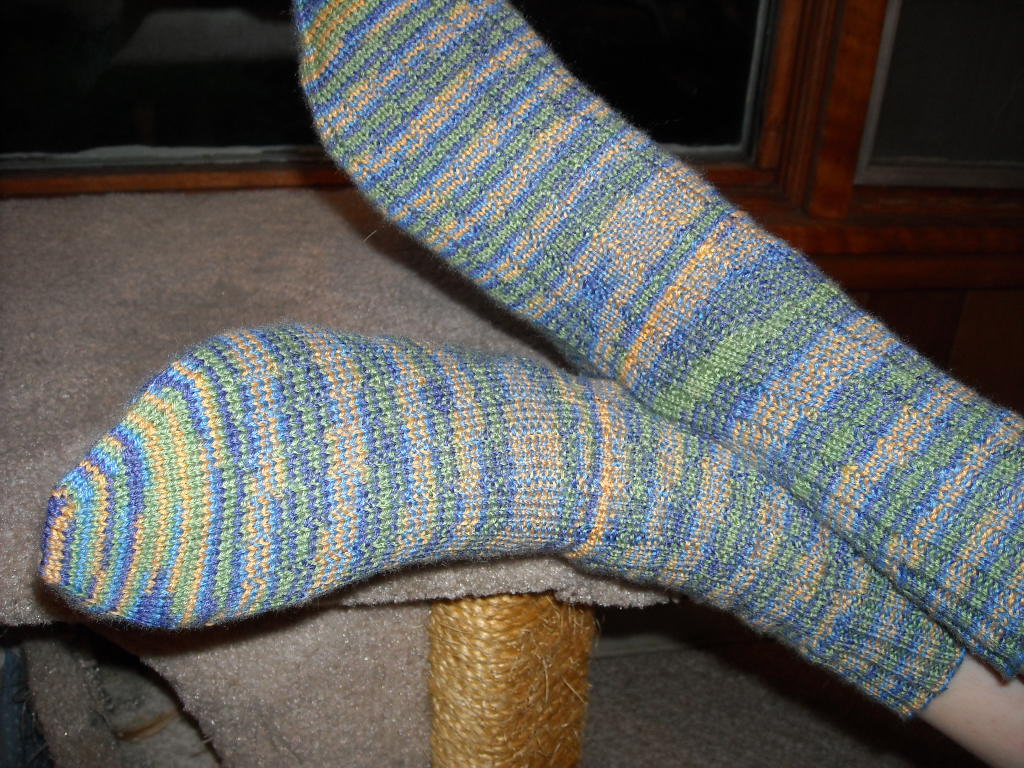
I'm writing about it now because I'm feeling a shift--ever so small, ever so subtle, but a shift. I've picked up my knitting several times in the last couple weeks. I finished Dexter's Christmas socks (poor kid!) just in time for the weather to get too warm for socks (sheesh; at least I made them a little big so he can wear them in the fall & winter).


I made a washcloth: last week I pulled out the one I started on the spring break trip when I was teaching a couple of my team members how to knit, and tonight I finished it. I've knitted a few rows on a lace scarf I started back in January. I'm even thinking about getting out the sweater I'm 3/4ths finished and seeing if I feel like tackling the second sleeve.

Just today, my wheel looks like an old friend I'd like to catch up with sometime soon.

Baby steps. I'm not pushing it, just listening inside for what feels right and going with that.

My knitting and spinning mojo was gone. And I mean really gone. But I think I feel it coming back.

May you feel some good mojo today!
Karen

Thursday, April 15, 2010

What I saw this morning


Streaks on the windshield where the dew gathered itself and trickled through the pollen dust.


A carpet of dogwood petals.


(These phrases formed in my head after I listened to an NPR story on poetry on my way to work this morning; the link here doesn't include the piece she read that blew me away, but it's got good stuff nonetheless...)


(And I feel compelled to offer this disclaimer again: I do not write poetry.)


I hope you have a moment to see the signs of spring around you!
Karen

Wednesday, April 14, 2010

On becoming un-stuck

Since our spring break trip I've been thinking about what happened on our first night, and what it might hold for me, for my thought processes.

We got stuck. We were staying at a house at a Methodist camp in the piney woods of Wisconsin. It was late, and dark, and rather cold. We took the wrong road, went past the back of the house instead of the front. And headed straight for the lake. Yikes!

(This is another time we got stuck--on our way out of S.D.!)


The first van stopped on the sandy shore. Sand is not so great a surface if you're trying to back up a rear-wheel drive van. The second van stopped further back--on solid ice. We tried all sorts of things to improve traction in both places: kitty litter, sticks, someone's coat. We dug and we pushed, we rocked the vans. Nothing worked; in fact, things seemed to get worse and worse with everything we tried.

(Maybe the kitty litter will work this time?)

I was not feeling so great, my head filling with anxious thoughts: Both vans are stuck and we're MILES from anywhere. Does Triple-A come out here? Will they have to call a special industrial-strength tow truck because the vans are big? How the heck would such a tow truck get down here without getting stuck as well? How much will it cost? Will we be up all night trying to figure this out? How are we going to tell Triple-A (or whomever) where we are, since we got a little lost on the way here? Have we damaged the transmission already with another 500 miles to drive tomorrow? Are we totally screwed? I need to fix this, I'm one of the "grown-ups" here; what happens if I don't know what to do?

I'm not a person who does really well in situations like this. I wish I could say I am resourceful and calm, a good problem-solver, but the truth is that I'm only occasionally like that. More often, I get nervous. I get scared when I feel like my safety is at risk. And for some reason, that's what it felt like that night.

All that put together meant that I was really talking myself down from a good freak-out. I kept hanging onto being grateful that no one was hurt (yet), and that we would figure out something.

Then somebody thought to call the camp director, who arrived in a few minutes. I thought, okay, at least he will know which tow company to call. But when he arrived, he came ready for ACTION!

He was driving a pickup truck full of good stuff--chains, shovels, a sand spreader--and was wearing a head lamp. Moments later, his staff arrived (staff? I thought nobody was here; it's practically still winter here!), about a half dozen young men and women with Wisconsin accents. And then we witnessed the true miracle of the evening: they were cheerful.

They were not freaked out at all. They were the opposite of freaked out. They kept telling various members of our group, "Oh, this is nothing. We've seen worse. We've seen MUCH worse!" They used the chains, they dug, they coaxed and cajoled and pushed, and in not very long, one van was out--up the hill and onto pavement.

And the whole time, I noticed that no one cussed. Okay, maybe that was the Methodist influence... but they weren't even cranky. No one snapped at anyone else or expressed frustration. No one even implied how pitiful (or worse) we were for getting two vans stuck in the first place. No one had a cross word to say, or even a negative thought, it seemed. They were confident and capable; they were laughing and joking. I was astonished.

(The piney woods of Wisconsin)

Around that time our student leader--who is definitely a problem-solver!--started planning for the next day. I was assigned to sleep so that I could drive the first shift in the morning, which was going to come really early. So I put away my anxious thoughts, and said some prayers to the four directions that the second van would be okay soon and that everyone would emerge from the adventure in one piece.

As I was soothing myself to sleep a while later, I heard a huzzah and knew the second van was out; we were going to be okay. And so I slept.

(The next morning; turkeys crossing the road...)

Every once in a while I think about getting both vans stuck, and I think about the other ways in which I feel stuck sometimes--in my academic writing, in my migraines, in my teaching or learning, in my relationships. And I wonder if I can stop freaking out (or nearly freaking out) and instead pretend I'm one of those people in Wisconsin.

I think about the cheerfulness of our rescuers, how they came in the cold, dark night and not only helped us get the vans out, but helped us feel better.

Is this what it means to get un-stuck? Is this what's possible?

I hope you feel free today,
Karen